Accepted upstream into Hermes Agent.
A SKYECON-authored fix for local-runtime GPU detection and automatic backend selection on Intel and AMD systems was incorporated into the public Hermes Agent main branch, with regression coverage.
British Columbia technology company
SKYECON offers government organizations, implementation teams, and operational businesses three paid, fixed-scope first engagements: verify a release, prepare a customer handoff, or assess a low-consequence call workflow before wider investment.
01 / Current work
SKYECON shows an externally incorporated contribution and real development work—specific, reviewable evidence rather than unsupported claims.
A SKYECON-authored fix for local-runtime GPU detection and automatic backend selection on Intel and AMD systems was incorporated into the public Hermes Agent main branch, with regression coverage.
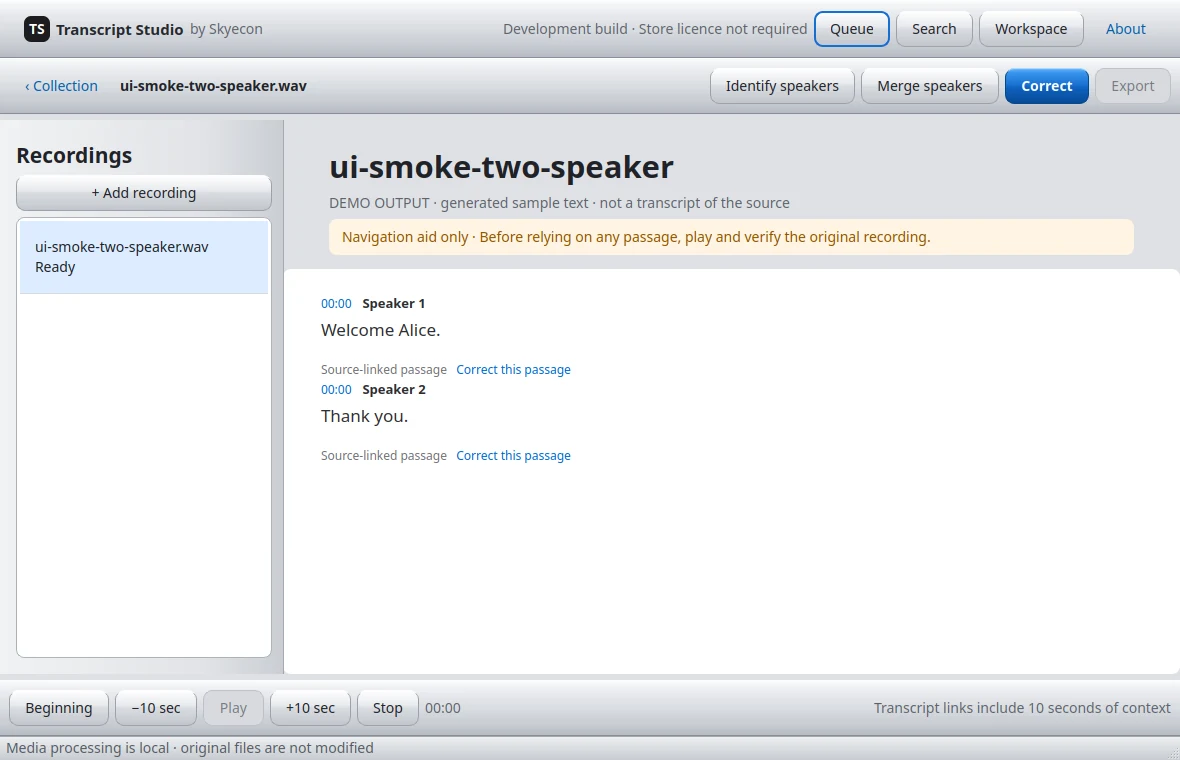
Development case — Transcript Studio
A SKYECON development project exploring local transcription, source-linked review, and human correction. Demonstrations use synthetic demonstration content. It is not a B.C. government deployment.
02 / Ways to start
Start with one release, acceptance event, or operational workflow. SKYECON defines the evidence and stop conditions before broader implementation is proposed.
For a buyer facing acceptance or release
Freeze one release, migration, integration, or acceptance boundary. Exercise the agreed catalogue and report what passed, failed, was blocked, or remains unverified.
Result A GO, CONDITIONAL GO, or HOLD recommendation with a reviewable evidence pack. SKYECON does not remediate work it assesses as independent buyer-side assurance.
Describe the decisionFor a delivery team approaching customer acceptance
Test one frozen delivery boundary before customer handoff. Reproduce critical paths, reconcile defects and uncertainty, and preserve the evidence behind the supplier's completion claim.
Result A delivery-side verification pack. It is never represented as independent buyer assurance when SKYECON supports the delivery team.
Prepare for acceptanceFor a repetitive operational call workflow
Map the baseline, compare voice with simpler options, define human fallback and measurable acceptance, and determine whether a demonstration or pilot is justified.
Result A build, buy, partner, verify, or stop decision. The assessment can conclude that no voice system should be built.
Assess the workflow04 / Public-sector fit
Public-sector teams face consequential release, migration, records, accessibility, authorization, and service-workflow decisions. SKYECON has submitted public patches to B.C. government repositories for external review. Those submissions demonstrate reviewable technical work; they are not contracts, deployments, acceptance, endorsements, or customer references.
The same operating discipline applies to commercial organizations with comparable operational constraints. Customer ownership, licensing, and deployment control are decided explicitly rather than assumed.
For an initial discussion, describe the outcome, present constraint, and acceptance test. Do not send credentials, protected records, private source code, recordings, or sensitive data.
Show us the workflow or decision